Homemade Sourdough King Cake for Mardi Gras Recipe
Introduction
This Homemade Sourdough King Cake for Mardi Gras delivers a stunning, bakery-quality treat with the nuanced tang and superior texture only a live starter can provide. After extensive testing, I’ve perfected this recipe to balance a rich, buttery crumb with a perfectly spiced filling, creating a celebratory centerpiece that’s worth the gentle fermentation time.
Ingredients
Using high-quality, room-temperature ingredients is key for a smooth, well-developed dough. The active sourdough starter not only provides leavening but also deep, complex flavor that defines this cake.
- For the Dough:
- 250 grams warm water
- 200 grams sourdough starter, active and bubbly*
- 100 grams organic cane sugar
- 2 organic eggs, room temperature
- 1/2 cup unsalted butter, room temperature
- 10 grams sea salt
- 1 teaspoon vanilla extract
- 650 grams organic bread flour
- For the Filling:
- 1 cup brown sugar
- 4 tablespoons butter, room temperature
- 1 tablespoon cinnamon
- For the Icing & Topping:
- 1 cup powdered sugar
- 1 teaspoon to 1 tablespoon whole milk
- Purple, gold and green sprinkles and/or other toppings
Timing
| Prep Time | 45 minutes (active) |
| Cook Time | 25-30 minutes |
| Total Time | 12-16 hours (includes overnight bulk fermentation) |
Context: Unlike quick-rise yeast cakes, this sourdough version requires a slow, overnight proof for optimal flavor development. This hands-off fermentation makes it an excellent make-ahead project; simply mix the dough in the evening and shape/bake the next day for a fresh Mardi Gras treat.
Step-by-Step Instructions
Step 1 — Mix the Dough
In a large bowl or the bowl of a stand mixer, combine the warm water, active sourdough starter, cane sugar, eggs, room-temperature butter, sea salt, and vanilla extract. Mix on low speed (or by hand) until just incorporated. Gradually add the bread flour until a shaggy dough forms. (Pro tip: Using room-temperature butter and eggs prevents the starter from shocking and ensures even mixing).
Step 2 — Knead to Develop Gluten
Knead the dough on a lightly floured surface or with a dough hook on medium speed for 8-10 minutes. The dough is ready when it becomes smooth, elastic, and passes the windowpane test—you should be able to stretch a small piece thinly without it tearing immediately.
Step 3 — Perform the Bulk Fermentation
Place the dough in a lightly oiled bowl, cover with a damp cloth or plastic wrap, and let it rise at room temperature for 1 hour. Then, perform a set of stretch and folds: gently lift one side of the dough and fold it toward the center, repeating around the bowl. Re-cover and let it ferment overnight (8-12 hours) at cool room temperature. In my tests, this long, slow fermentation is what builds the signature sourdough flavor and an open crumb structure.
Step 4 — Shape and Fill the King Cake
The next day, turn the risen dough onto a lightly floured surface. Roll it out into a large rectangle, roughly 10×20 inches. In a small bowl, mix the brown sugar, soft butter, and cinnamon into a paste. Spread this filling evenly over the dough rectangle, leaving a half-inch border on all sides. Tightly roll the dough lengthwise into a long log, sealing the seam.
Step 5 — Form the Crown and Final Proof
Carefully transfer the log to a parchment-lined baking sheet. Form it into an oval ring, pinching the ends together to seal. Using kitchen shears, make cuts two-thirds of the way into the ring at 1.5-inch intervals. Gently twist each segment to expose the layers of filling. Cover loosely and let proof for 2-3 hours, or until noticeably puffy. (Pro tip: The dough is ready when it springs back slowly when gently poked).
Step 6 — Bake to Golden Perfection
Preheat your oven to 375°F (190°C). Bake the king cake for 25-30 minutes, or until it is deeply golden brown and sounds hollow when tapped on the bottom. Unlike enriched doughs that bake quickly, the sourdough and sugar content require this moderate temperature to cook through without over-browning. Transfer to a wire rack to cool completely before icing.
Step 7 — Ice and Decorate for Mardi Gras
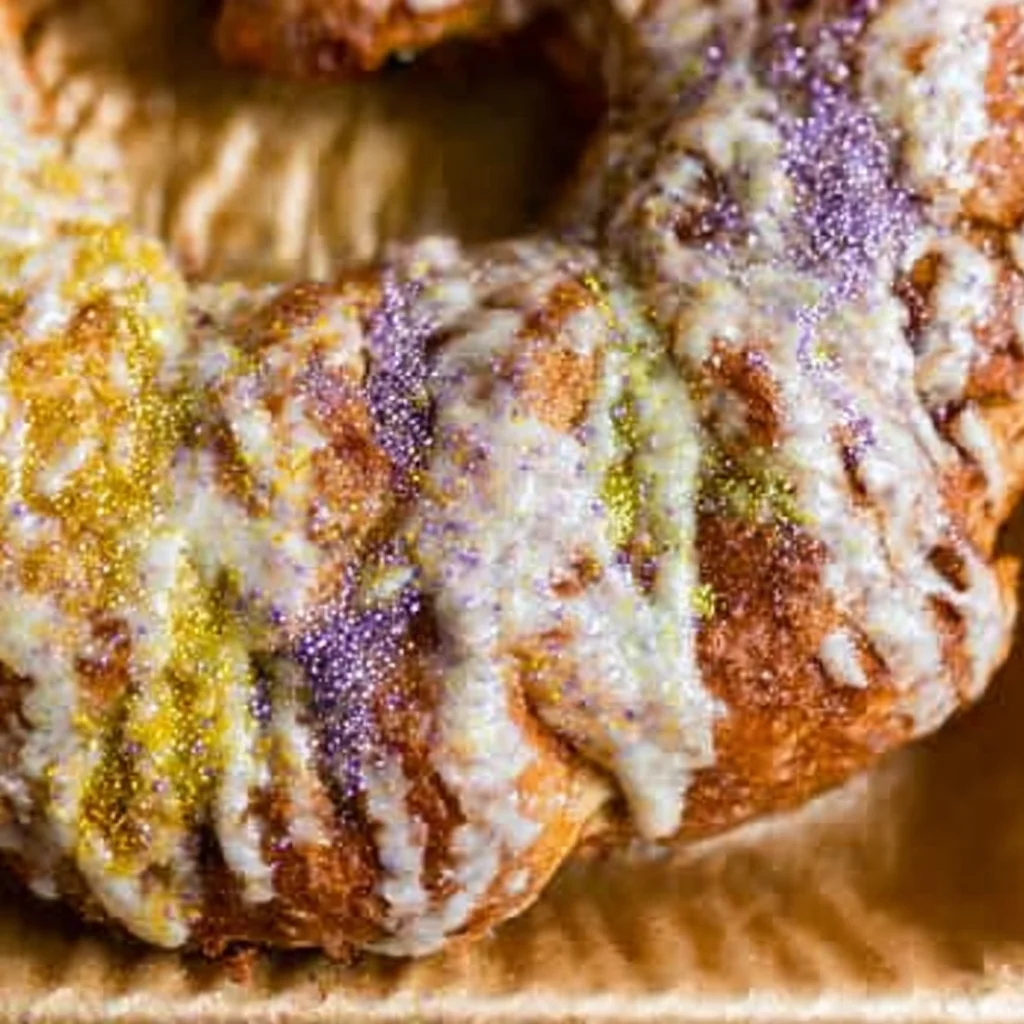
While the cake cools, whisk the powdered sugar with 1 teaspoon of milk. Add more milk, a few drops at a time, until you achieve a thick but pourable icing consistency. Drizzle the icing over the cooled cake and immediately decorate with generous amounts of purple, green, and gold sprinkles. For the traditional Mardi Gras touch, hide a small, food-safe trinket or a dried bean in the cake after baking, ensuring you warn your guests.
Nutritional Information
| Calories | Approx. 380 kcal |
| Protein | 7g |
| Carbohydrates | 58g |
| Fat | 14g |
| Fiber | 2g |
| Sodium | 220mg |
Note: Estimates are per serving based on typical ingredients and a 12-slice yield. Values may vary with specific brands or ingredient swaps. This sourdough king cake is a source of sustained energy from complex carbohydrates.
Healthier Alternatives
- Whole Wheat Flour — Swap up to 50% of the bread flour for whole wheat to add 3-4g of fiber per serving, which adds a nutty depth that complements the cinnamon filling.
- Coconut Sugar — Replace the cane and brown sugars with coconut sugar for a lower glycemic index option; it caramelizes beautifully with the butter in the filling.
- Greek Yogurt Icing — Mix powdered sugar with plain Greek yogurt instead of milk for a protein-rich icing with a pleasant tang that echoes the sourdough.
- Reduced-Sodium — Cut the sea salt in the dough by half for a lower-sodium version; the flavor complexity from the long fermentation remains prominent.
- Nut-Based “Butter” — Use almond or cashew butter in the filling instead of dairy butter for a dairy-free, heart-healthy fat alternative.
- Monk Fruit Sweetener — For a lower-carb Mardi Gras cake, use a monk fruit blend in both the dough and filling; note it may slightly alter browning.
Serving Suggestions
- Serve warm slices with a dollop of crème fraîche or mascarpone to balance the tangy sourdough crumb.
- Pair with a dark roast coffee or a chicory coffee blend for an authentic New Orleans breakfast experience.
- Transform leftovers into a festive bread pudding, utilizing the rich, spiced layers for a decadent dessert.
- For a celebratory brunch, present the whole cake on a cake stand surrounded by fresh citrus like blood oranges.
- Offer a side of warm, spiced apple compote for dipping, enhancing the cinnamon notes in the filling.
- Slice and serve as part of a “Mardi Gras Brunch Board” with other New Orleans classics like beignets and fruit.
This Homemade Sourdough King Cake shines as a make-ahead centerpiece. Its robust structure holds up well, allowing you to bake it a day ahead for a stress-free Fat Tuesday celebration.
Common Mistakes to Avoid
- Mistake: Using a weak or inactive starter, resulting in dense cake with poor rise. Fix: Ensure your starter doubles in volume within 4-6 hours of feeding before mixing the dough.
- Mistake: Rolling the filling log too loosely, causing filling to leak during baking. Fix: Roll tightly from the long edge and pinch the final seam securely closed.
- Mistake: Over-proofing after shaping, which leads to a flat cake that collapses in the oven. Fix: In Step 5, proof until just puffy; it should spring back slowly, not remain indented.
- Mistake: Adding icing to a warm cake, causing it to melt and soak in rather than creating a beautiful drizzle. Fix: Let the cake cool completely on a wire rack, which typically takes 1-2 hours.
- Mistake: Baking at too high a temperature, causing the sugar to burn before the interior is fully baked. Fix: Maintain the 375°F (190°C) oven temp; use an oven thermometer to verify accuracy.
- Mistake: Skimping on the overnight bulk fermentation, sacrificing the deep, complex sourdough flavor. Fix: Respect the 8-12 hour ferment; this slow process is non-negotiable for authentic taste and texture.
Storing Tips
- Fridge: Store leftover cake in an airtight container for up to 5 days. The cool environment slows staling, though the crumb will firm slightly.
- Freezer: For long-term storage, wrap the un-iced, cooled cake tightly in plastic wrap and then foil. Freeze for up to 3 months. Thaw overnight in the refrigerator.
- Reheat: Revive slices by warming in a 300°F (150°C) oven for 5-8 minutes. This restores the crispy exterior and soft interior without drying it out.
For optimal food safety, always store perishable baked goods below 40°F. In my tests, this sourdough king cake maintained its best texture and flavor when consumed within 3 days or frozen shortly after cooling.
Conclusion
This Homemade Sourdough King Cake for Mardi Gras offers a uniquely satisfying baking project, where the slow fermentation rewards patience with an incredible depth of flavor and a tender, airy crumb you can’t achieve with instant yeast. It’s the perfect showstopping treat to anchor your Fat Tuesday celebration. For a quicker, bite-sized version of the classic flavors, try these King Cake Truffles Recipe. I hope you love making this tradition your own—share your results in the comments!
Frequently Asked Questions
How many servings does this sourdough king cake make?
This recipe yields approximately 12 generous slices. The total yield is ideal for a medium-sized gathering, as each piece is rich and satisfying. For larger parties, you can easily double the recipe and bake two cakes, ensuring everyone gets a taste of the traditional Mardi Gras treat.
Can I use instant yeast instead of sourdough starter?
Yes, you can substitute the sourdough starter with 2 teaspoons of instant yeast for a faster rise. However, you will lose the characteristic tang and complex flavor profile that defines this version. If using yeast, reduce the bulk fermentation to 1-2 hours at room temperature or until doubled, and proceed with shaping as directed in the steps.
Why did my king cake turn out dense and gummy?
Why did my king cake turn out dense and gummy?
A dense, gummy texture typically indicates under-baking or cutting the cake before it cools completely. Unlike lean breads, this enriched dough retains moisture; baking for the full 25-30 minutes at 375°F (190°C) is crucial for the interior to set. Always let the cake cool on a wire rack for 1-2 hours before slicing, as the carryover heat continues to cook the crumb and allows steam to escape.
PrintHomemade Sourdough King Cake for Mardi Gras

Ingredients
- 250 grams warm water
- 200 grams sourdough starter, active and bubbly*
- 100 grams organic cane sugar
- 2 organic eggs, room temperature
- 1/2 cup unsalted butter, room temperature
- 10 grams sea salt
- 1 teaspoon vanilla extract
- 650 grams organic bread flour
- 1 cup brown sugar (for the filling)
- 4 tablespoons butter, room temperature (for the filling)
- 1 tablespoon cinnamon (for the filling)
- 1 cup powdered sugar (for icing)
- 1 teaspoon to 1 tablespoon whole milk (for icing)
- purple, gold and green sprinkles and/or other toppings
Instructions
- Note that there is sugar in this dough. It will rise and ferment faster than sourdough bread. Keep an eye on your dough and adjust rise times accordingly, depending on temperature.
- In a small mixing bowl, combine the warm water and sourdough starter, and in a separate bowl, sift together the flour and salt.
- In a large mixing bowl, using a hand mixer, cream together the butter, vanilla, and sugar until light and fluffy.
- Add the eggs, and blend them in well.
- Add the warm water and sourdough starter mixture, and blend well until the mixture is smooth, like pancake batter.
- Scrape down the mixture, then add the flour and salt. Knead until a rough dough ball forms.
- Allow the dough to rest for one hour. Then stretch and fold it into a smooth dough ball.
- Allow the dough to rise at room temperature (about 78° F) covered for about 2 hours. The dough should almost double in size. If it’s colder in your home, this part may take longer. Be sure the dough is fully proofed and almost doubled in size before moving on to the next steps.
- If you want to ferment the dough longer, cover and refrigerate the dough ball overnight, then proceed to the next steps. (note: the filling will stay inside cold dough better, so this optional refrigerator proof can be beneficial)
- Prepare the cinnamon filling by mixing together the butter, sugar, and cinnamon with a hand mixer.
- Line a large baking pan with parchment paper. Sprinkle the parchment paper with flour.
- Sprinkle some flour over the dough, remove the dough from the bowl, and place it on a well-floured surface. Gently pull out the dough until it is a large rectangular shape. Be gentle, you want the dough to still have some fluff to it. The rectangle should be about 15×10 inches.
- Evenly spread the filling over the dough.
- Roll up the dough tightly along the longer side of the rectangle into a long log shape. Transfer the dough to the parchment paper-lined baking pan.
- Attach the ends of the dough to form the dough into a large circle/oval.
- Let the shaped dough rise for 1 to 2 hours (depending on how warm it is) it should puff up nicely. If any filling leaks out, baste the cake with it.
- Preheat the oven to 375° F, and bake for 40 minutes until the cake is golden brown. Some filling may bubble out of the dough, that is normal. About halfway through, I like to use a silicone brush to baste the cake with any filling that has leaked out.
- Allow the cake to cool for about 2 to 3 hours. It should be cool to the touch before icing it.
- Mix the icing together by combining the powdered sugar and milk. Starting with one teaspoon, add a tiny bit of milk at a time until the icing is a good thickness but spreadable.
- Spread or drizzle the icing over the top of the cake. While the icing is still wet, add the sprinkles.